
Research & Academic Partners
NYB partners leading academic and research institutions to bridge fundamental discovery to translational innovation and therapeutic innovation.
By integrating our AI-first platforms with biomedical expertise, these partnerships strengthen scientific rigor, and facilitate breakthroughs in therapeutic and preventive health solutions.
Flagship Collaboration
NYB–NTU Joint Laboratory
NYB has established a 6,000 sq. ft joint laboratory with Singapore’s NTU to advance drug discovery using AI and natural compounds. NTU is ranked 12th globally (2026 QS World University Rankings) and ranked 3rd in Asia (2026 QS Asia University Rankings).
“We are very excited about this venture with NYB,” said Assoc Prof Li Hoi Yeung. “The multi-disciplinary approach taken by our laboratory will form the basis of our journey for the discovery of natural compounds as future therapeutics to target cancer, metabolic and neurodegenerative diseases.”
Drawing from a collection of around 300 herbs and medicinal plants in NTU's Community Herb Garden, this collaboration bridges traditional knowledge with modern pharmaceutical science to transform bioactive compounds into viable therapeutic and nutraceutical candidates.
Since 2019, the NYB-NTU Joint Laboratory for Drug Discovery and Therapeutics has been tackling four key research focus areas: drug discovery, artificial intelligence (AI), organic and medicinal chemistry, and genomics and metagenomics.
Assoc Prof Adams Kong explained, “A vast quantity of data is available for natural compounds. Using AI algorithms, we can screen for drug-like molecules at scale, which is not feasible for traditional screening approaches.”
What This Collaboration Delivers
- AI-first compound selection from tropical plants and herbs
- In vitro and in vivo validation of lead compounds
- Studies on gut microbiome and immune response
- Chemical fingerprinting for standardization and quality control
- Genomic analysis of medicinal plants for biosynthetic insights
- Metagenomic studies to support sustainable cultivation
.jpg)
Our Innovation Ecosystem
Research Focus
The NYB-NTU Joint Laboratory for Drug Discovery and Therapeutics focuses on four key areas of research to develop preventive, adjuvant and therapeutic options for cancers, metabolic and neurodegenerative diseases to bring profound healthcare benefits to Singapore and the world’s ageing population.
“Nature has provided us with rich resources that can be harnessed for the development of future therapeutics. The challenge is to translate the bioactive compounds in the herbal extracts into drug candidates. Given the complexity of plant extracts, it would be exciting to explore the therapeutic synergy between the key natural compounds in the mix.” - Prof Koh Cheng Gee
Research Focus
Key Research Areas
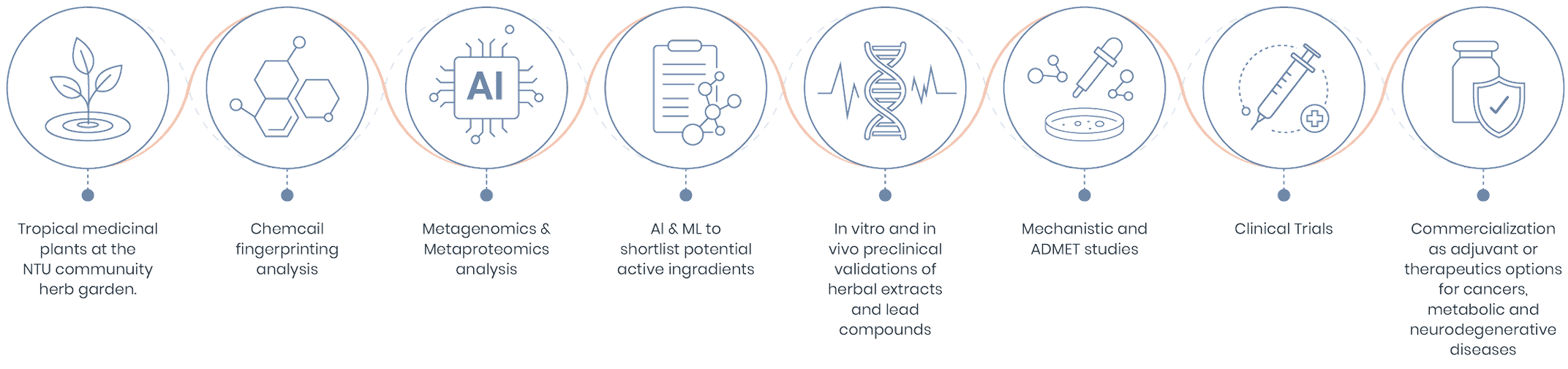
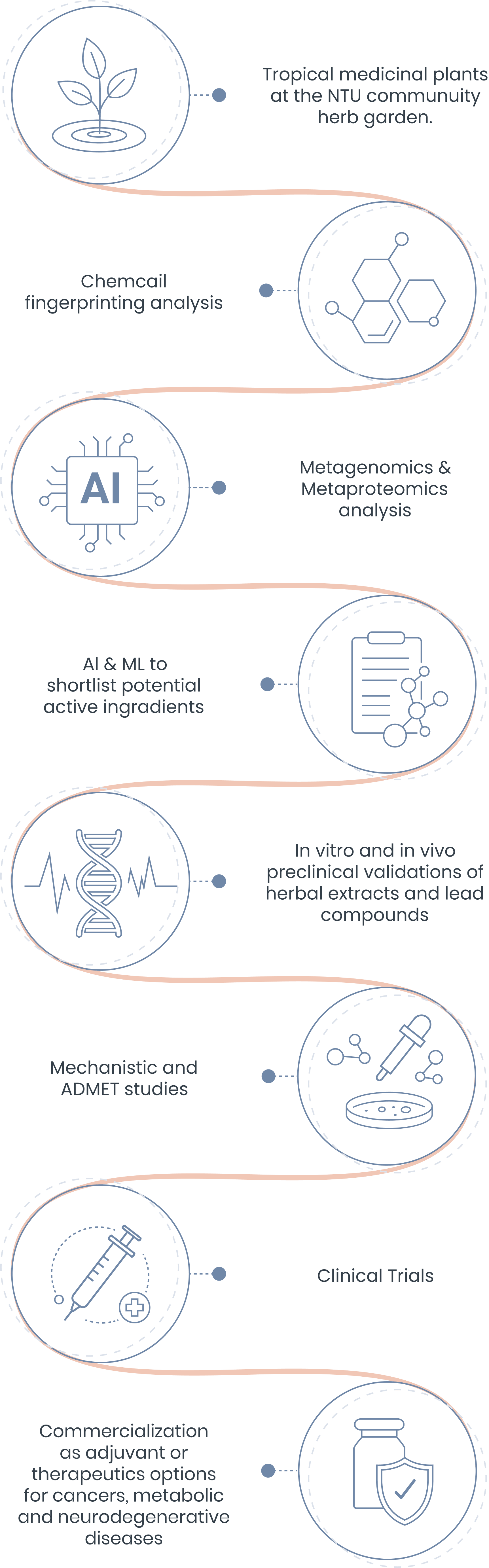
Historically, natural compounds have contributed much to drug discovery, particularly in cancer and infectious diseases. The processes of screening, isolation and optimization of natural compounds are long and challenging. Many of the medicinal plants used in our research are not well characterised. Neither is there any standardisation to ascertain the quality of different batches of plants. Our team of organic chemists will first work to provide thorough chemical fingerprints for all the plants used. They will also design and improve the structures of the natural compounds of interest to make them more drug-like.
In vitro and in vivo analysis and validations: We will apply suitable purification methods to purify the compounds shortlisted by the AI algorithm based on their chemical properties from the raw tropical plants/herbs. The isolated compounds will be subjected to in vitro and in vivo validations as summarised below. Lead compounds can be chemically modified based on their chemical properties to increase efficacies. Chemically modified derivatives will be subjected for further in vitro and in vivo analysis and validations.
Gut microbiome and immunity: We will determine how lead compounds and their derivatives might affect the composition of gut microbiome and immunity using appropriate animal models.
Mechanistic studies: We will carry out biochemical and cell biology experiments to determine the underlying molecular and cellular mechanisms of action for the tropical plant/herb extracts, lead compounds and their derivates.
Machine learning (ML) and data mining will be applied to build an Artificial Intelligence (AI) algorithm based on existing drug/chemical databases for the treatment of different diseases. After chemical fingerprinting of the tropical plants/herbs, we will perform in-silico screening to identify potential lead compounds using our proprietary AI algorithm. The AI/ML approach will also allow us to build a pharmacopoeia for precision medicine tailored to different patients.
We will carry out genomic analysis to identify tropical plants/herbs as part of the standardisation process. Genomic studies of the tropical plants provide an insight into the biosynthetic pathways of lead compounds, which can be applied for future high-yield production of lead compounds using synthetic biology. Metagenomic analysis of soil microbiome can help to identify beneficial microbes for herb cultivation.
NTU Community Herb Garden
The NTU Community Herb Garden was founded in 2009 by a group of volunteers to help the needy to manage and alleviate the discomfort of diseases ranging from high blood pressure to cancer. It was inspired by Mr Ng Kim Chuan and the beneficial outcome of his brother’s cancer treatment through the medicinal herbs he was growing. Today, the garden features over 300 species of medicinal plants and continues to give out plants to the community for free. It also suppliesplants to NTU’s School of Biological Sciences for research purposes.
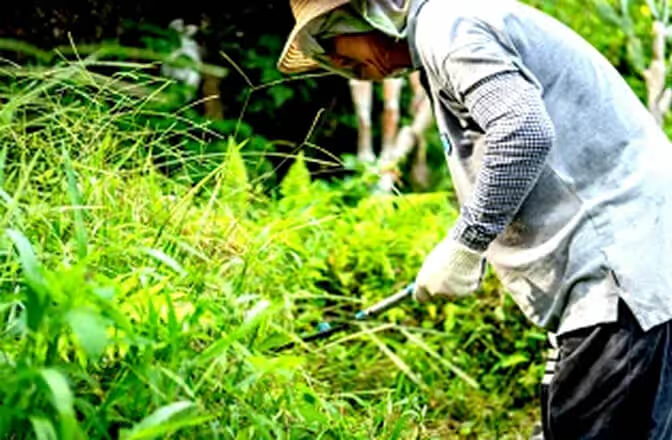
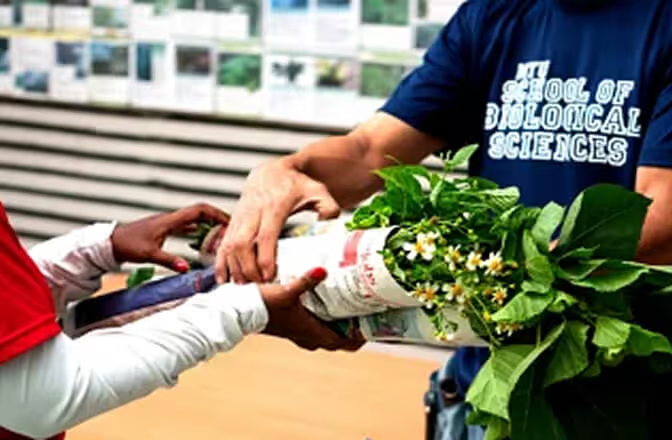
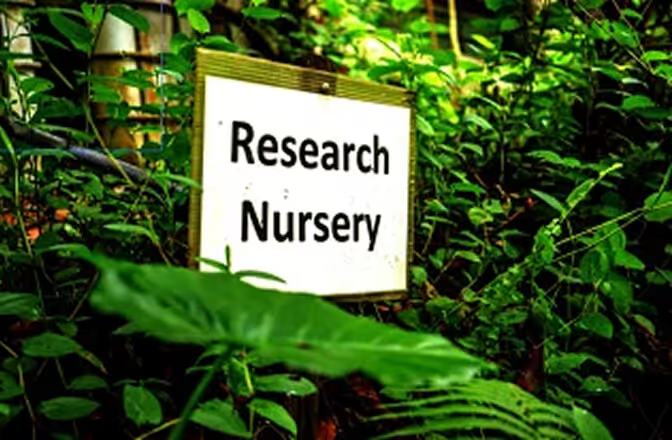
Source: NTU Community Herb Garden
Supplying active ingredients for tomorrow’s nutraceuticals
The garden’s role in supporting research at NTU received a huge boost with the establishment of the NYB-NTU Joint Laboratory for Drug Discovery and Therapeutics. The lab actively pursues research in developing nutraceuticals, drugs and therapeutics from the medicinal plants grown in the garden.